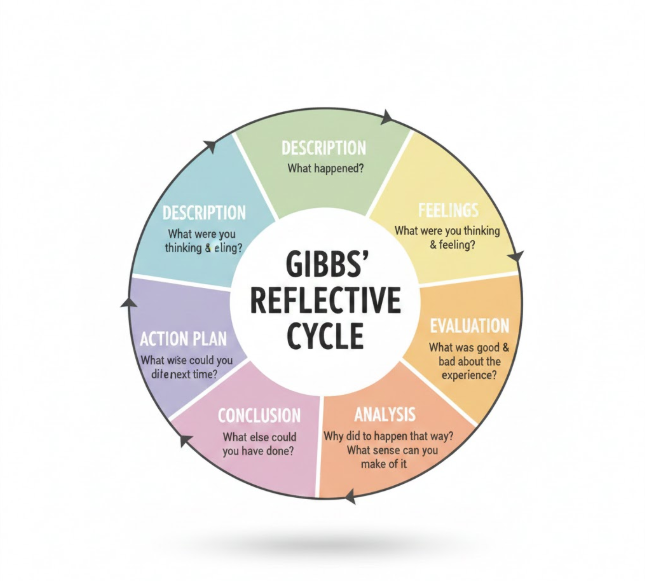
Reflective practice is the heartbeat of the nursing profession. It is not just about thinking back on what you did during a shift; it’s a structured process that transforms a simple clinical experience into a powerful learning opportunity. For many nursing students, the “reflective essay” is one of the most challenging parts of their degree. You aren’t just reporting facts; you are analyzing your own emotions, mistakes, and successes to become a better practitioner. Among the various frameworks available, Gibbs’ Reflective Cycle is the most widely used because it provides a clear, circular path from the initial event to a future plan of action.
When you are tasked with documenting clinical hours, the pressure to be both academically rigorous and deeply personal can be overwhelming. Many students find that utilizing a professional nursing essay writing service like MyAssignmentHelp can provide the necessary structural guidance and expert insight to ensure their reflections meet the high standards of healthcare education. By seeing how experts handle the nuance of Gibbs’ Cycle, students can better understand how to balance their subjective feelings with objective clinical evidence. This foundational understanding is crucial because reflection is not just an assignment—it is a lifelong skill required for professional revalidation and patient safety.
Understanding the Six Stages of Gibbs’ Cycle
Graham Gibbs published his cycle in 1988, and it remains popular because it encourages “learning by doing.” The cycle consists of six distinct stages: Description, Feelings, Evaluation, Analysis, Conclusion, and Action Plan. By following these steps, you avoid the common mistake of simply “storytelling” and instead move into “critical thinking.”
Stage 1: Description (What happened?)
In this first stage, you set the scene. Imagine you are a camera recording the event. Do not try to analyze anything yet; just provide the facts.
- When and where did the event take place?
- Who was involved (patients, mentors, other staff)?
- What did you do, and what was the outcome?
Tip: Keep this section concise. A common mistake is spending 50% of your word count on the description. In a 1,500-word essay, your description should only be about 200–250 words.
Stage 2: Feelings (What were you thinking?)
Nursing is an emotional job. This stage asks you to be honest about your mindset. Were you terrified because it was your first time inserting a catheter? Were you frustrated by a lack of communication during a code blue?
- How did you feel before the event?
- How did you feel during and after?
- What do you think others felt?

Stage 3: Evaluation (What was good and bad?)
Now, look at the situation objectively. Evaluation is about judging the experience. Even in a situation that went wrong, there is usually something positive (e.g., “I stayed calm even though the patient was aggressive”).
- What went well?
- What didn’t go as planned?
- How did the patient or their family respond to your actions?
Stage 4: Analysis (Why did things happen the way they did?)
This is the most important part of your essay for your grades. Analysis involves linking your experience to academic theory. If a patient’s condition deteriorated, don’t just say it happened—explain the pathophysiology or the nursing theory behind your response. Students often look for quantitative nursing research topics to find data that supports their clinical decisions during this stage. Referencing high-quality data from quantitative nursing research topics—such as studies on patient fall rates or medication error statistics—allows you to compare your specific clinical experience with broader national trends, which is a hallmark of high-level academic writing.
Stage 4: Analysis: Connecting Theory to Practice
In the analysis phase, you must ask “Why?” If a wound dressing became infected, was it due to a break in aseptic technique, or were there underlying patient factors like diabetes? This is where you cite your textbooks and journals. You are proving to your professors that you aren’t just a “doer,” but a “thinker” who understands the science behind the care.
Stage 5: Conclusion (What else could you have done?)
In the conclusion, you summarize your learnings. This is not about the patient; it is about you.
- What did you learn about your own skills?
- If you had been better prepared, could the outcome have changed?
- What specific skills (communication, technical, time management) do you need to improve?
Stage 6: Action Plan (If it happens again, what will you do?)
The cycle is only a “cycle” if it leads to change. Your action plan is a bridge to your future self.
- If this exact situation happened again, what would you do differently?
- What training do you need? (e.g., “I will attend a workshop on de-escalation techniques.”)
- How will you ensure you have the necessary knowledge next time?
Why E-E-A-T Matters in Nursing Reflection
Google and academic institutions both look for E-E-A-T (Experience, Expertise, Authoritativeness, and Trustworthiness). To make your reflection rank well and read professionally:
- Experience: Use first-person language (“I observed,” “I felt”) because this is your lived experience.
- Expertise: Use correct medical terminology (e.g., “tachycardia” instead of “fast heart rate”).
- Authoritativeness: Reference the Nursing and Midwifery Council (NMC) or the American Nurses Association (ANA) guidelines.
- Trustworthiness: Acknowledge your mistakes. A nurse who can admit an error and learn from it is more trusted than one who pretends to be perfect.
Common Pitfalls to Avoid
- Being too descriptive: Don’t just tell a story. Analyze it.
- Ignoring the “Feelings” section: Many students feel “unprofessional” talking about emotions, but in Gibbs’ cycle, emotions are data.
- Poor referencing: Always link your analysis to evidence-based practice.
- Vague Action Plans: Don’t say “I will do better.” Say “I will complete the BLS (Basic Life Support) certification by next month.”
See also: Countertop Materials Quartz vs Granite: A Clear Comparison of Durability, Cost, and Style
Final Thoughts for Nursing Students
Writing a Gibbs’ reflective essay is a rite of passage. It’s the moment you stop being a student who follows orders and start being a professional who evaluates care. By breaking the cycle down into these six manageable steps, you can turn a stressful assignment into a roadmap for your clinical career.
If you find yourself stuck on the “Analysis” or “Evaluation” stages, remember that seeking a mentor or looking at high-quality examples can make all the difference. Whether you’re researching quantitative nursing research topics or looking for a structured nursing essay writing service from MyAssignmentHelp, the goal is the same: to provide the best possible care for your patients through continuous self-improvement.
Frequently Asked Questions
1. What is the main purpose of using Gibbs’ Reflective Cycle in nursing?
The model provides a structured framework for nurses to process clinical experiences deeply. Instead of just remembering an event, it guides you to analyze your emotions and actions, linking them to professional standards to improve future patient care.
2. How does the “Analysis” stage differ from “Evaluation”?
Evaluation focuses on what went well or poorly during the experience. Analysis goes a step further by asking why those things happened, often requiring you to connect the event to academic nursing theories or clinical evidence to find deeper meaning.
3. Can I use this model for positive experiences?
Yes. While often used to learn from mistakes, the cycle is equally effective for analyzing successful outcomes. Reflecting on why a specific intervention worked allows you to replicate that success and build confidence in your professional skills.
4. What should a nursing action plan include?
An effective action plan should be specific and achievable. It should outline the exact steps you will take if the situation recurs, such as attending a specific training workshop, practicing a technical skill, or changing how you communicate with a multidisciplinary team.
About the Author
Georgia Taylor is a dedicated academic consultant and guest contributor for MyAssignmentHelp, specializing in healthcare education and student mentorship. With years of experience in clinical theory and professional development, Georgia focuses on simplifying complex academic frameworks to help the next generation of nurses transition confidently from the classroom to the hospital ward.